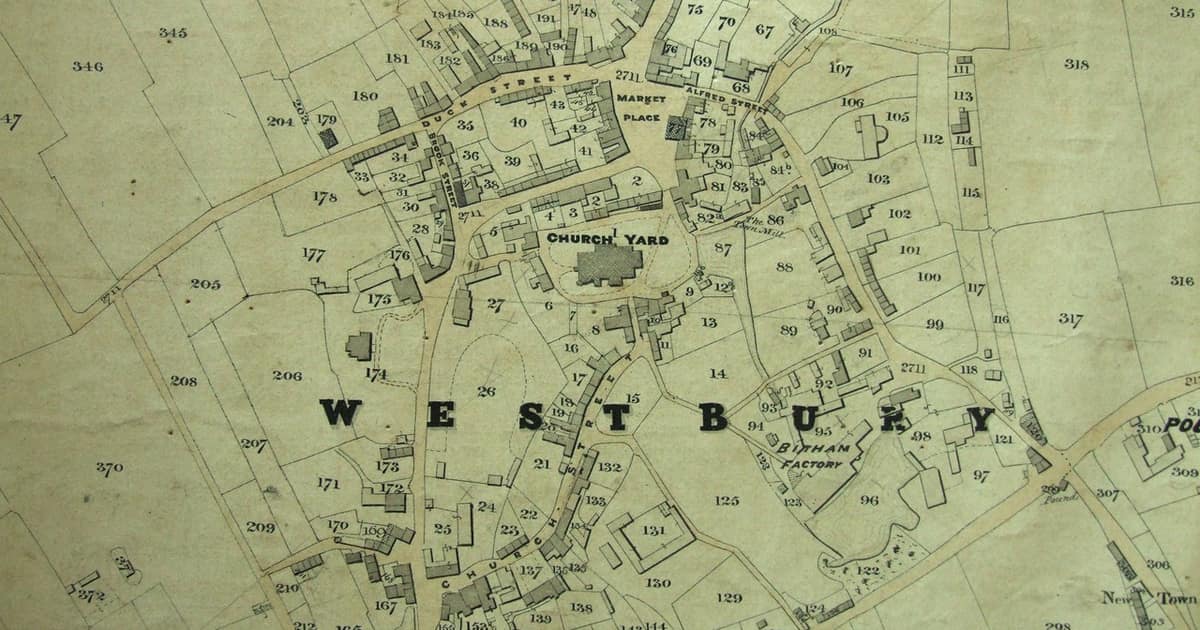
Map: Cotterells & Cooper, Surveyors, Bath, Somerset, public domain via Wikimedia Commons.

Start at your local archive, not Kew, and work backwards from the present. The National Archives' own guide to houses says that a county or borough record office is the best place for ownership and construction history, since it will usually hold local maps, electoral registers and family and estate papers. National records are most useful for telling you who lived there in particular years.
Below is the order we would follow for a house in England or Wales. Scottish and Irish records differ, and we flag this where it matters.
Step 1: Look at the house
Before you open any record, form a guess. A rough date from the brickwork and windows tells you which sources are likely to mention the house, and which are not worth your time. Check whether it has a list entry, and note any earlier house name or number you come across, since you may need it to find older entries.
Step 2: Ask what paperwork already exists
Title deeds are the obvious hope, and often a disappointment. Under the Law of Property Act 1925 there is no obligation to keep title evidence for more than 30 years, so older deeds may have been thrown away. The National Archives suggests asking HM Land Registry, your solicitor and your mortgage company. Deeds can also turn up in a solicitor's collection deposited at an archive, or among family and estate papers.
Step 3: Visit the local archive
Use the "Find an archive" search on The National Archives' site to identify the right office. Then ask about:
- old maps of the street;
- electoral registers;
- building plans, which many archives hold from the mid-19th century onwards and which can show how a house originally looked;
- estate papers, if the land belonged to a large landowner;
- working copies of the Valuation Office Survey, covered in step 5.
It is worth emailing first, so that you can find out what survives before you travel.
Step 4: Find the occupants
Two national sources will take you through the last two centuries of residents, although The National Archives warns that they reveal little about the house itself.
The 1939 Register was taken on 29 September 1939 to produce identity cards and ration books, and it can be searched by address on Findmypast and Ancestry, both paid sites.
The census was taken every ten years, and the guide to census records covers 1841 to 1921 for England and Wales. Exact addresses were required from 1851, so earlier returns can be vague. Searching on Ancestry or Findmypast is free, while viewing images generally costs money, but libraries and record offices often give free access to 1841 to 1911. The 1921 census is free to view at Kew, Manchester Central Library and the National Library of Wales.
Two gaps catch people out. The 1931 census for England and Wales was destroyed by fire in 1942, and no census was taken in 1941. So there is a long gap between 1921 and 1939. Scottish returns are on ScotlandsPeople, and Irish ones are free on the National Archives of Ireland website.
One detail is easily missed. The 1911 enumerators' summary books list every address, including empty buildings, and are the only census source to describe the type of building, with entries such as "House and shop".
Step 5: Use the 1910 valuation
The Valuation Office Survey of 1910 to 1915 was created for land taxation and is the most descriptive of the national sources. It can reveal a property's value and use, its area, the number of rooms and sometimes how they were used, along with owners, occupiers and tenancy details.
The catch is that it comes in two parts: field books and index maps. You need the index map to find the right field book. The records are held at Kew, so access means a visit, paid research or a paid copy if you have the reference. Local archives often hold working copies, so ask there first.
Step 6: Go back to the tithe map
The Tithe Survey followed the Tithe Commutation Act of 1836 and produced maps that are often older than the earliest Ordnance Survey sheets for the area. The map (series IR 30) has numbered plots, and the apportionment (IR 29) lists owners, occupiers and land use against each number.
Be clear about what it proves. As The National Archives puts it in the houses guide, tithe records can confirm that a property existed and give clues about ownership and occupancy, but they do not describe the building. A built-up plot in 1842 may contain an entirely different structure from the one you see today. Do not expect every plot to have been surveyed either, because the survey and valuation were aimed at places where tithes were still being paid in kind.
Images are online at The Genealogist, a paid site. Copies were also sent to diocesan registrars and parishes, and many now sit in local record offices, with some counties publishing scans on their own websites. Try those first.
Step 7: Work out what you actually know
By this point you should have a table of names and dates, and a set of maps. Compare your list against what the house looks like. If a map shows a different footprint from today, you have found a rebuilding or an extension. If the building appears on the 1842 map but its windows and front look decades later, it may well have been refaced.
When you want more depth, the guide recommends a short reading list, including Nick Barratt's Tracing the History of Your House and Gill Blanchard's Tracing Your House History, and Nat Alcock's book on title deeds. If your research turns up a notable resident, you may even have the start of a case for a plaque.
Keep a note of every reference you consult, including those that showed nothing. A record you have already ruled out is worth knowing about, and it saves the next owner the same afternoon.
+End of the trailAdd a stop of your own: write for us