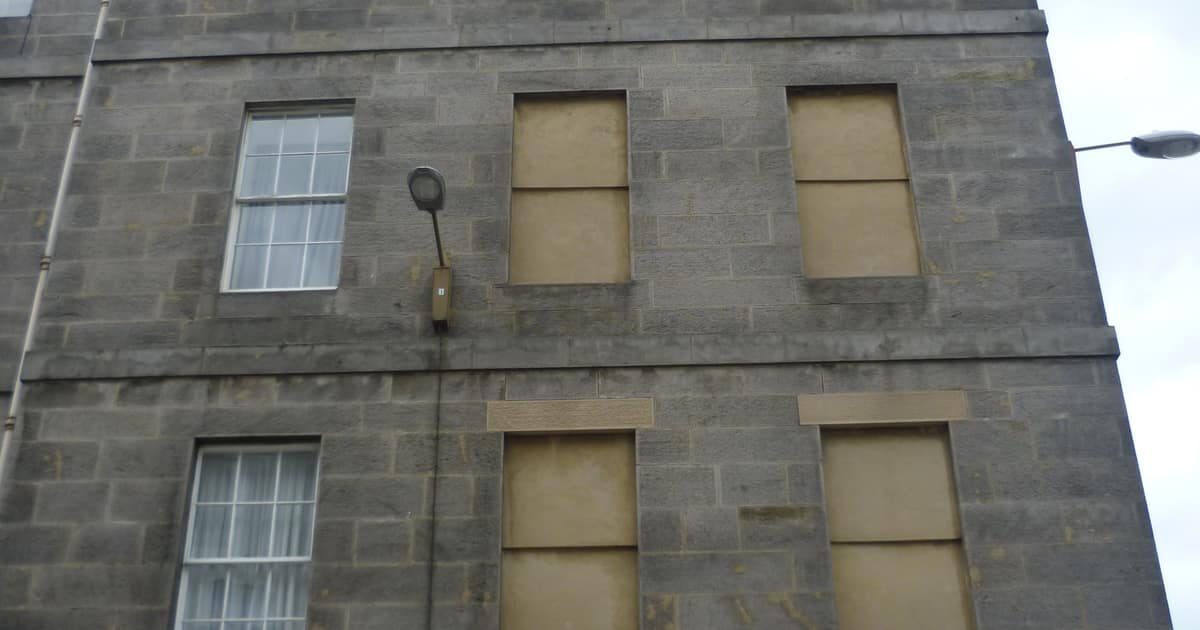
Photo: Kim Traynor, CC BY-SA 3.0, via Wikimedia Commons.

Sometimes. The window tax did lead owners to block windows, and it ran for more than 150 years, from 1696 to 1851. But a blank window is not proof of it. Many blank openings were planned from the start to balance a Georgian facade and never held glass. To tell which you are looking at, you need to examine the brickwork around the opening, and often you still cannot be certain.
What the tax actually was
William III's government introduced it in 1696 to raise revenue, using windows as a rough measure of what a house was worth. Wallace Oates and Robert Schwab, writing for the Lincoln Institute of Land Policy, give the first schedule: 2 shillings per house, plus 4 shillings for houses with 10 to 20 windows, or 8 shillings for those with more than 20. One attraction was practical. The earlier hearth tax of 1662 had sent assessors into people's homes, whereas windows could be counted from outside.
The rates moved a good deal after that. They rose in 1784 to make up for lower tea duties, and the Triple Assessment of 1797 tripled them to help pay for the French wars. Thresholds moved as well, which matters when you stand in front of an old house, because the number of windows it was worth having depended on the year.
Scotland had its own version. ScotlandsPeople says the tax was levied there from 1748 until 1851. Its rolls first listed properties with ten or more windows, then eight or more from 1762, and from October 1766 seven or more windows or a rent of at least £5 a year.
Did people really block them up?
Yes, and the evidence goes beyond old stories. Oates and Schwab looked at window counts for houses in Ludlow from 1747 to 1757 and found spikes at 9, 14 and 19 windows, just below points at which the charge jumped. Households were evidently choosing how many windows to have. They also describe owners boarding windows up or building with very few, leaving some floors with no windows at all.
Parliament noticed. In 1747 it legislated against blocking a window to escape assessment and then reopening it, with a penalty of 20 shillings for each window reopened. The law's vagueness also bred arguments over what a window was: Oates and Schwab mention an 1848 case about a hole in a coal cellar wall.
The burden fell unevenly. They cite an 1850 Commons debate suggesting that in London the tax could reach about 30 per cent of the rent on smaller houses in Baker Street, and 40 to 50 per cent on other streets, while large houses typically paid about 5 per cent. Tenements were taxed collectively, which hit the poor hardest, and poor ventilation became a public health argument against the tax. It was repealed in 1851 after a winter of agitation; the Winckley Square history site gives the date as 24 July, and says that a tax on inhabited houses replaced it.
The other kind of blank window
Georgian builders cared about symmetry, and a regular front did not always suit the rooms behind. A false window could keep the rhythm of the facade where the rooms behind would otherwise have spoiled it. Blank wall also gave more space inside for furniture and pictures. The Winckley Square article, by Steve Harrison, describes owners in Preston keeping their glass on the walls that overlooked their gardens and leaving side walls facing the street blank.
A window of that kind owes nothing to the tax, however convincing the story told about it on a guided tour.
How to judge one in the street
The Winckley Square piece offers a rule of thumb, and we have turned it into a short routine. It will not settle every case, so keep "probably" in your vocabulary.
- Compare the brick. If the panel is in the same brick as the wall, and the mortar courses run through at the same levels, the opening was probably built as a blank.
- Look at the sill and lintel. Matching details around the blank and its neighbours suggest it belongs to the original design. On their own they prove little, since a blocked window keeps its surround.
- Check the recess. A neat step back in the brick where the glass would have sat is typical of a planned blank. A filling flush with the wall, in different brick, looks more like a later change.
- Stand back. Does the blank window complete a pattern on the front? A side wall with blanks scattered at odd heights invites a different explanation, perhaps a change in the rooms behind.
- Date the wall. A building put up well after 1851 cannot have blocked a window to avoid this tax. Dating the front comes first.
A blocked window can also come from later causes altogether, such as a new floor level, a neighbour's extension, or simply a change of use. A window that was blocked and has different brick might have been filled at any point in two or three hundred years.
Finding out for certain
Documents can occasionally help. The Scottish rolls name householders and the number of windows in their properties, though ScotlandsPeople warns that entries can be thin on location and that the rolls are not available as transcriptions. So you may be able to compare a count with what stands today, if you can tie the entry to the house. For English houses, start with the local record office and ask what assessments survive for the parish.
If you are planning a town walk, blocked windows make a good stop for exactly this reason. People enjoy being told a story, and they enjoy it more when they are shown how to question it.
4Next stopWho gets a blue plaque?