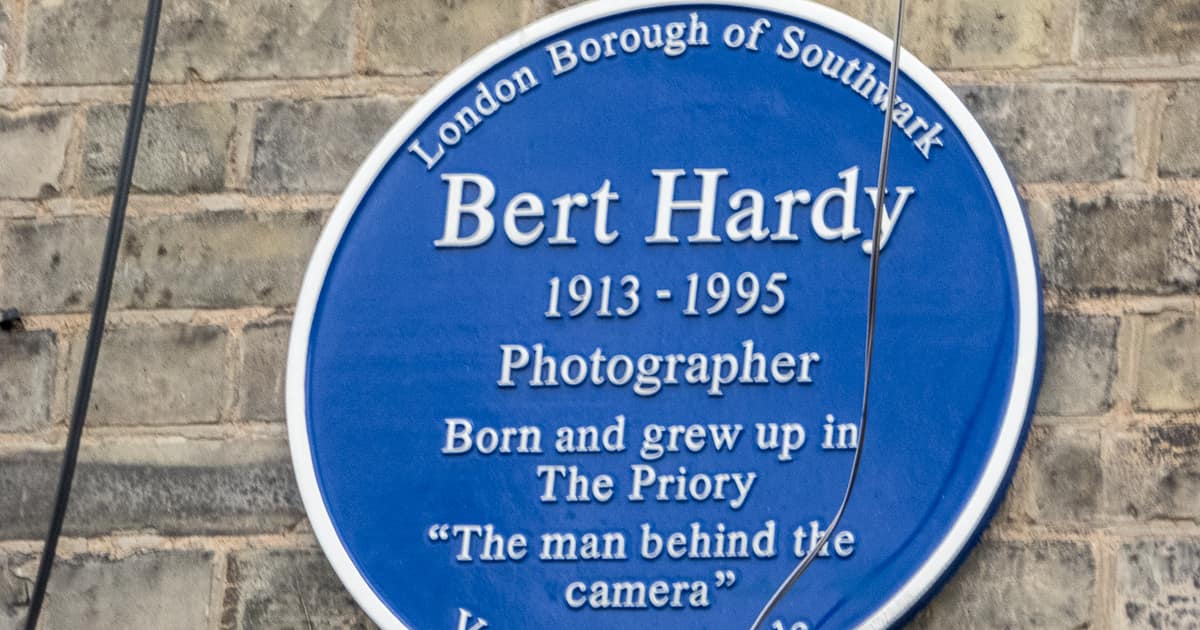
Photo: Christine Matthews, CC BY-SA 2.0, via Wikimedia Commons.

In London, the official scheme is run by English Heritage. A nominated person must have been dead for at least 20 years, a building closely tied to them must survive in Greater London, and an expert panel has to agree. Anyone can propose a name. Outside London, or on a plaque with a different issuer's name round the rim, a separate set of rules applies, and a blue colour on its own tells you very little.
The rules for London
The English Heritage proposal page is specific, and worth reading if you have someone in mind. In short:
- At least 20 years must have passed since the person's death.
- At least one associated building must survive in Greater London, outside the City of London, which runs its own scheme.
- The building should look as it did when the person lived there and be visible from a public road.
- Churches, schools and theatres are not normally considered.
- Each person gets only one plaque, and a building can carry no more than two.
The 20-year rule exists so that decisions can be made, in English Heritage's words, with "a sufficient degree of hindsight". Buildings linked to an event or group may also be considered, depending on resources.
From nomination to wall
The route is slow by design. You check whether the person already has a plaque, then email a brief outline, and English Heritage will say if the idea is already under consideration or was declined. A declined proposal can only come back after ten years. If it is worth pursuing, you complete a nomination form with evidence that the person really lived at the address, which might mean biographies, electoral registers, Post Office directories or census returns.
The Blue Plaques Panel meets three times a year to decide its shortlist. After shortlisting, a plaque usually takes two to three years to go up, allowing for further research and for the owner's consent. Listed building consent may be needed as well. Each plaque is handmade and fired twice in a kiln, and that stage alone takes several months.
Proposals can fail if the person's historical significance is unclear or if the link to a surviving London building is weak, so the strength of the address evidence matters as much as the fame of the name.
If you are collecting evidence for an address, the same sources you would use for a house history will serve you here.
A short history in six dates
The English Heritage history calls it the oldest scheme of its kind in the world, and it has had several owners.
| Year | What happened |
|---|---|
| 1863 | William Ewart MP proposes the idea in the House of Commons |
| 1867 | The Society of Arts puts up its first two plaques. Lord Byron's birthplace in Holles Street comes first, though the house was demolished in 1889. The Napoleon III plaque on King Street is the earliest still standing |
| 1903 | First plaque from the London County Council, to Thomas Babington Macaulay |
| 1921 | Blue ceramic has become the standard by this date, after trials of other colours and decoration |
| 1938 | An unnamed student at the Central School of Arts and Crafts produces the simplified design, for a fee of four guineas |
| 1986 | English Heritage takes over from the Greater London Council. Its first plaque honours the painter Oskar Kokoschka |
The Greater London Council, which ran the scheme from 1966 to 1985, broadened the range of people commemorated and pushed into areas such as Richmond, Croydon and Redbridge. The scheme has not always been secure: government cuts threatened it in 2013 and 2014, and private donations secured its future.
English Heritage now counts more than 1,000 plaques across London, in all but two boroughs, Havering and Hillingdon. Those early plaques are not all blue, either, which is one of the pleasures of looking at them. Society of Arts plaques have patterned borders carrying the Society's name, and those of the London County Council added a laurel wreath.
Why your town's plaque may be something else
Round plaques have become a general way of marking local memory, so a plaque in a market town is unlikely to belong to the London scheme. English Heritage notes that Historic England runs a scheme for England outside London, and that local councils and other organisations run their own. The City of London has its own too, and English Heritage suggests Westminster City Council's Green Plaques and the Nubian Jak Community Trust as alternatives for proposals it declines.
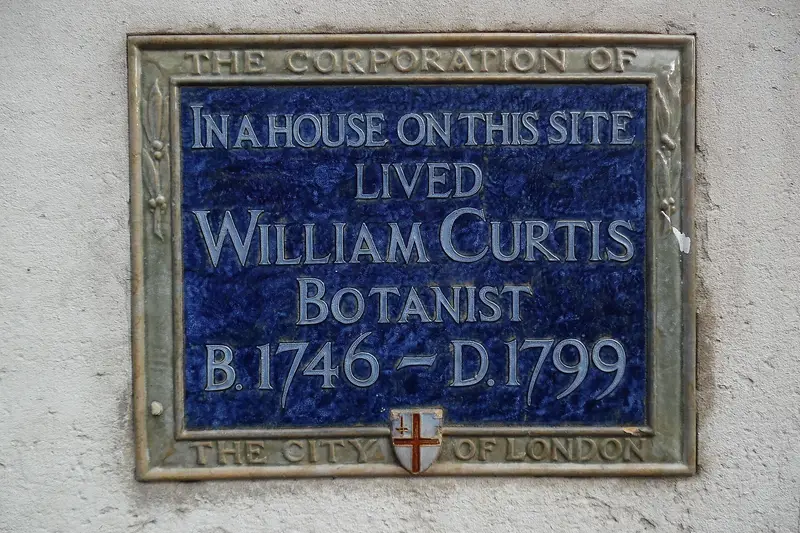
Photo: David Hillas, CC BY-SA 2.0, via Wikimedia Commons.

The photograph at the top of this page shows one from Southwark with the wording "voted by the people". The rules behind plaques like these vary, so read the rim before you assume anything.
Reading a plaque as evidence
A plaque is a useful lead on a walk, but it deserves a little scepticism. Three things to check:
Who issued it? The issuer's name is usually on the plaque. That tells you whose standards were applied, and where to go to ask about the evidence.
Does it say "lived here" or "on this site"? English Heritage's current rule requires a surviving building, but it says plainly that earlier plaques sometimes marked demolished sites and that the 20-year rule was not always applied. A plaque can be old enough to pre-date the rules now in force.
Is the wall the same wall? A plaque marks an association, and it does not date the front of the building. The house may have been refaced or altered before or after the person lived there. If the plaque is on your walking route, look it up first and say what you can actually support.
5Next stopWhat listed building grades mean